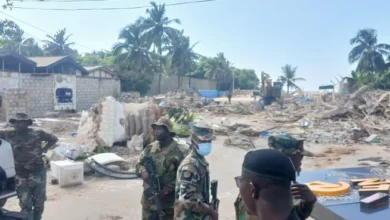
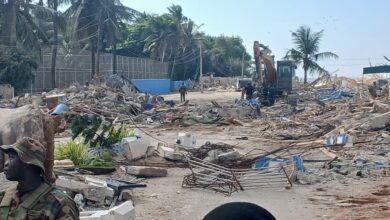
‘The Damage Has Been Extensive’ — Mahama Commiserates with Accra Flood Victims After Aerial Assessment
President blames climate change, poor sanitation and blocked waterways as government rolls out emergency relief and long-term flood mitigation measures.
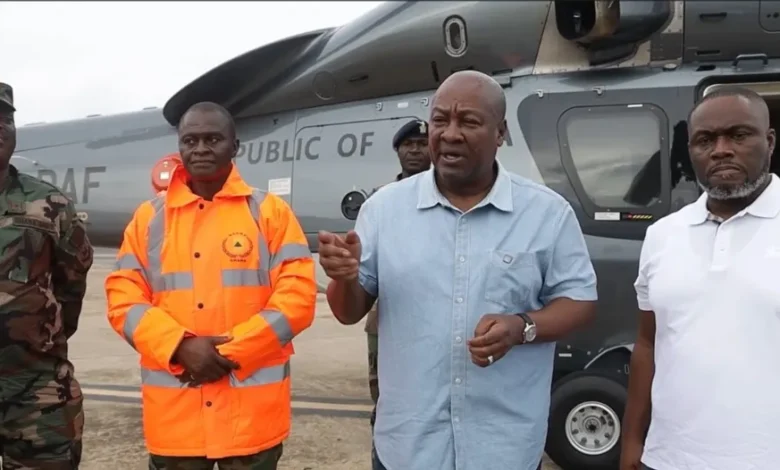
- Mahama sympathises with flood victims after aerial tour.
- Climate change and poor sanitation blamed for worsening floods.
- Government announces emergency relief and tougher enforcement.
President John Dramani Mahama has expressed heartfelt sympathy to victims of Sunday’s devastating floods in Accra, describing the destruction as extensive and warning that climate change, poor sanitation and unchecked development continue to worsen the capital’s flood crisis.
Speaking after an aerial inspection of flood-affected communities on June 29, President Mahama said many families had suffered significant losses following one of the heaviest rainfall events recorded in recent years.
“I wish to express my deepest sympathy to all those who have lost property as a result of today’s floods. The damage has been extensive, and many families have been severely affected,” he said.
The President disclosed that preliminary data showed approximately 140 millimetres of rainfall fell over Accra in a single day—more than double the highest daily rainfall recorded in 2025, which stood at about 56 millimetres.
He attributed the worsening floods partly to climate change, noting that rainfall in Accra has increased steadily over the past three years.
According to figures from the Ghana Meteorological Agency (GMet), Accra recorded about 85 millimetres of rainfall during a 30-day period in June 2024. That figure increased to 172 millimetres in June 2025 before rising sharply to approximately 333 millimetres in June 2026.


President Mahama explained that the increasing frequency and intensity of rainfall leave little time for waterways to recover, making flooding more severe.
Beyond climate change, he blamed engineering challenges and human activities for aggravating the situation.
The President lamented the continued dumping of refuse into drains and wetlands, revealing that some individuals illegally convert wetlands into dumping sites before selling the reclaimed land for housing developments.
“During today’s aerial inspection, we observed several illegal dumping sites located within wetlands. Some individuals have turned these wetlands into refuse disposal sites, charging operators of tricycles to dump waste there. Once these wetlands become filled with refuse, the same individuals sell the reclaimed land to unsuspecting people for housing development, further worsening the flooding situation,” he stated.
He stressed that the flooding crisis must be addressed through both engineering interventions and strict enforcement, including reopening blocked drainage channels and removing structures obstructing the natural flow of water.
President Mahama announced that the National Security Council will meet to coordinate urgent interventions, while Metropolitan, Municipal and District Assemblies (MMDAs), working with the Ministry responsible for Works, Housing and Water Resources, will identify and remove all obstructions along major drainage channels.
He also reiterated government’s long-term strategy to decongest Accra by developing a new urban growth centre outside the capital, with plans to relocate some public institutions and provide roads, water and electricity to support future development.
Commending emergency responders for their swift action, President Mahama praised the Ghana Armed Forces, the National Disaster Management Organisation (NADMO), the Ghana Police Service, the Ministry responsible for Works and Housing and the 48 Engineers Regiment for rescuing stranded residents and preventing further loss of life.
He further directed NADMO to identify affected victims for immediate assistance and instructed the Minister for Finance to release funds from the Contingency Fund to support post-flood relief efforts.
The President concluded by urging Ghanaians to change their attitude towards sanitation, waste disposal and construction in flood-prone areas, stressing that lasting solutions are needed to end Accra’s recurring flood disasters.
“This time, we must act differently. Together, we must ensure that lasting solutions are implemented so that this cycle of devastating floods does not continue year after year,” he said.