Mahama Urges UN to Establish Global Framework for Return of Africa’s Cultural Heritage
President calls for permanent mechanisms to facilitate restitution and the unconditional return of African human remains.
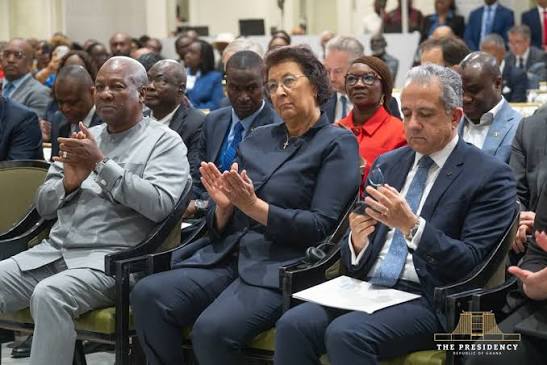
- Mahama calls for permanent restitution mechanisms.
- President demands their unconditional return.
President John Dramani Mahama has called for the establishment of a permanent global framework to facilitate the restitution of Africa’s cultural heritage, including the unconditional return of human remains held in foreign institutions.

Speaking at the Next Steps High-Level Side Event on Reparatory Justice on the sidelines of the 81st United Nations General Assembly in New York on Wednesday, September 23, 2026, President Mahama urged the United Nations and countries holding African artefacts to move beyond individual acts of restitution.
“Our next step is to build a permanent, institutionalised global system.”
He called for clear and standardised legal and diplomatic procedures to support provenance research, improve access to archives and reduce legal barriers to the return of cultural property.
The President said the process should begin with the unconditional return of human remains.

“Human remains are not collectibles. They are not specimens. They are our ancestors.”
Restitution is about people
President Mahama said the restitution debate should not be viewed simply as an issue involving objects displayed in museums, but as part of a broader struggle for dignity and justice.
“This is not a story about static objects in museum cases. It is a story about people. It is a story about dignity. It is a story about an unfinished journey toward justice.”
He cited Ghana’s experience, recalling the destruction of Kumasi by British forces in 1874 and the subsequent looting of the Asantehene’s palace.
He noted that part of the heritage, including the sacred Mpomponsuo sword, was returned to Ghana in 2024.
According to the President, the return demonstrated that such artefacts remain connected to living traditions, institutions and communities.
He said similar instances of cultural dispossession occurred in Benin City in 1897, Maqdala in Ethiopia and Abomey in present-day Benin.
Call for return of human remains
President Mahama described the removal of ancestral remains as one of the most painful forms of dispossession.
He highlighted the case of King Badu Bonsu II of Ahanta, who was executed by Dutch colonial authorities in 1838. His head was subsequently taken to the Netherlands and preserved for decades before being returned to Ghana in 2009.
The President said the case demonstrated why the return of human remains should be treated as a matter of human dignity rather than ownership.
“Restoring them is not a matter of legal ownership; it is a fundamental test of our shared human dignity.”
Capacity should not delay restitution
President Mahama also rejected arguments that African countries must first develop modern facilities before cultural artefacts can be returned.
“Capacity constraints must never be used as a justification for continued possession. Capacity must serve as a bridge to return, not a barrier to justice.”
He pointed to initiatives including the African Union’s Agenda 2063 flagship project, the Great African Museum, and the AU-EU Museum Partnership as examples of efforts to strengthen Africa’s capacity to preserve and manage its heritage.
He also highlighted Ghana’s investment in national and traditional institutions to preserve, research and exhibit returned artefacts.
Where gaps remain in technology, digitisation and conservation, he called for international partnerships and investment to address them.
President Mahama concluded that cultural heritage should not be treated as a secondary issue to be addressed after economic development, arguing that it can also serve as an engine for development.