Fresh Twist in Wontumi Case as Minerals Commission Clarifies Contract Mining Rules
Minerals Commission clarification could impact Wontumi’s appeal.
- No assignment deeds found.
- Contract mining differs from mineral-right assignment.
- Wontumi’s appeal gains fresh attention.
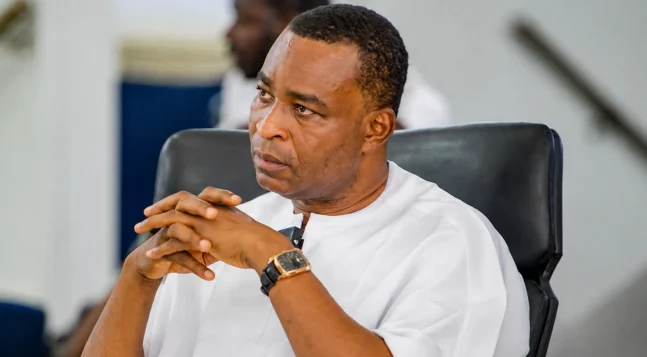
The embattled former Ashanti Regional Chairman of the opposition New Patriotic Party (NPP), Mr. Bernard Antwi-Boasiako, popularly known as Chairman Wontumi, who is currently serving a 20-year jail sentence, has been handed a major lifeline following a critical disclosure by the Minerals Commission regarding the ownership and assignment of mineral rights.
A Right to Information (RTI) request filed by mining consultant Ing. Wisdom Edem Gomashie has produced a official response from the Minerals Commission addressing the legal distinction between contract mining and the assignment of mineral rights.
This issue lies at the very heart of one of the key charges that led to Antwi-Boasiako’s conviction.

Chairman Wontumi was convicted by the High Court on July 20, 2026, and sentenced to 20 years’ imprisonment on charges including the assignment of a mineral right to a third party without ministerial approval, under Section 14 of the Minerals and Mining Act, 2006 (Act 703).
As he awaits his fate following an appeal filed by his legal team, the latest revelations from the RTI response appear to significantly strengthen his defense.

Ing. Gomashie, who testified as a defense witness during the trial, wrote to the Minister for Lands and Natural Resources and the Minerals Commission on August 6, 2026, invoking the Right to Information Act, 2019 (Act 989). He requested copies of deeds of assignment between 11 major mining companies and the mine-support-service providers undertaking contract mining on their behalf.
The list included Goldfields Ghana (Tarkwa), Newmont Ghana (Ahafo South), AngloGold Ashanti (Obuasi and Iduapriem), Perseus Mining (Edikan), and Asanko Gold Mine, among others.
The Ministry of Lands and Natural Resources forwarded the request to the Minerals Commission on August 14, 2026. In its response dated August 20, 2026, signed by Acting Chief Executive Officer Isaac Tandoh, the Commission stated unequivocally that no deeds of assignment exist between mineral right holders and their support-service providers.
The Commission clarified that while Section 14 of Act 703 governs the assignment of mineral rights, it does not apply to contract mining. It emphasized that under Section 59 of Act 703 and the Minerals and Mining (Support Services) Regulations, 2012 (L.I. 2174), companies may register with the Commission as mine-support-service providers to offer specialized services to mineral right holders.
The Commission explicitly noted that this arrangement is legally distinct from an assignment of mineral rights, which strictly requires the Minister’s prior written approval under Section 14. Furthermore, it affirmed that a mineral right holder does not assign its mineral rights simply by engaging a support-service provider for contract mining.
This distinction hits at the core of the state’s case, in which Chairman Wontumi was sentenced for allegedly assigning mineral rights to one Henry Okum without ministerial approval. Based on the Minerals Commission’s official position, neither Chairman Wontumi nor Akonta Mining acted illegally by engaging Henry Okum to execute reclamation works.
The Commission’s clarification is expected to play a central role in Wontumi’s pending appeal against his conviction and sentence. The development has left legal observers questioning the basis of the 20-year sentence in the absence of documentary proof of assignment.
With the legal vacation ending in October, reports indicate that Chairman Wontumi’s legal team is preparing to seek bail pending appeal, setting the stage for an intense courtroom showdown in the coming days.