Mahama Declares Africa’s Reparations Demand Unified and Unstoppable at AU Meeting in Malabo
President Mahama, serving as the African Union’s Champion for Reparations, calls for global solidarity as the AU extends its reparations agenda through 2036, emphasizing justice, dignity, and historical redress
- AU extends reparations agenda from 2026 to 2036 following Mahama’s progress report
- Mahama urges global partners to support Africa’s pursuit of justice and restitution
- Ghana and Togo to co-host UNGA 2025 high-level event on reparative justice
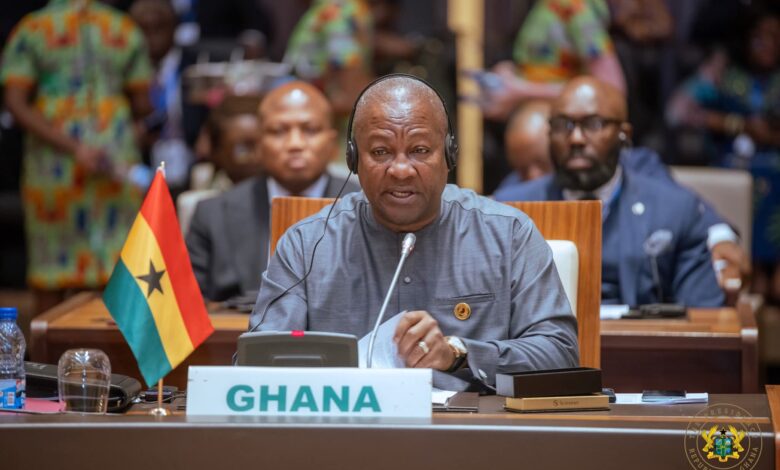
Ghana’s President and African Union (AU) Champion for Reparations, John Dramani Mahama, has declared that Africa’s long-standing call for reparative justice is no longer a subdued appeal but a “unified demand” rooted in historical truth, moral clarity, and the continent’s quest for dignity.
Speaking at the 7th Mid-Year Coordination Meeting of the African Union in Malabo, President Mahama provided a progress report on the AU’s 2025 Theme of the Year: “Justice for Africans and People of African Descent through Reparations.”
“Africa’s call for reparative justice is no longer a whisper—it is a unified demand… We reaffirm our resolve to correct historical wrongs through restitution, healing, and systemic transformation,” he said.
Decade-Long Focus on Reparations
Mahama welcomed the AU Executive Council’s decision to extend the focus on reparations by an additional decade—from 2026 to 2036—which he described as a strategic move to sustain momentum and mobilize resources for implementation across member states.
“This affords us the opportunity to map out thoughtful strategies to realize this noble cause domestically,” he noted.
The former Ghanaian leader called for international collaboration, urging countries across the globe to join Africa in shaping a just and equitable global system.

“We call upon all nations, within and beyond Africa, to partner with us in this effort to build a fairer world for the sons and daughters of the motherland,” Mahama appealed.
Reparations Tied to Identity, Dignity, and Unity
Highlighting the profound link between reparations and African dignity, Mahama stressed that true development cannot be pursued without acknowledging the continent’s fractured heritage.
“Restitution to the African is the restoration of full human dignity… We must speak of history on African terms, heal civilizational wounds, and reclaim our rightful agency in shaping our destiny,” he emphasized.
He also underscored the importance of building partnerships with the Caribbean, particularly CARICOM, in advancing the reparations agenda on the global stage.
Ghana, Togo to Lead Reparations Push at UNGA
As part of efforts to deepen global engagement, President Mahama announced that Ghana and Togo will co-sponsor a high-level reparations event on the sidelines of the 2025 United Nations General Assembly (UNGA) in New York.
“As we act to correct historical wrongs, we are reasserting our full humanity and sovereignty. We are reigniting the flame of dignity that has always burned within the African soul,” he stated.
Mahama reaffirmed Ghana’s full commitment to advancing the AU’s reparations agenda, in line with the continental vision of achieving “The Africa We Want.”