Over 3 Million Pupils Learn Under Trees as Classroom Deficit Persists – Auditor-General
The 2025 Auditor-General's Report reveals that 10,730 public basic schools across 13 regions lack classroom blocks, leaving millions of pupils in temporary learning spaces.
- 3 million pupils lack classrooms.
- 10,730 schools have no classroom blocks.
- Auditor-General calls for urgent action.
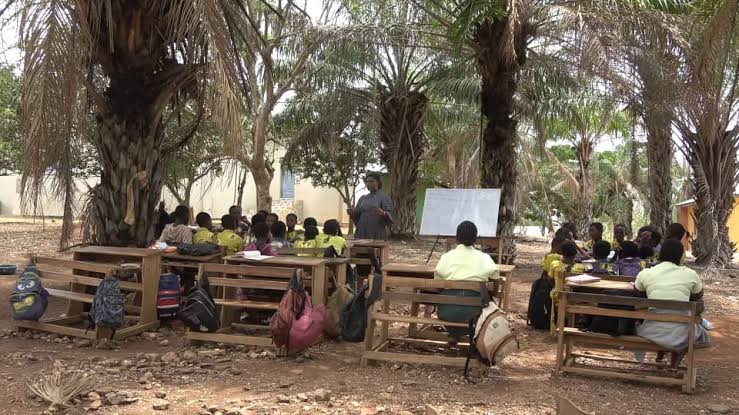
More than three million pupils across 13 regions are still receiving lessons under trees, in churches, sheds and other temporary structures due to the lack of classroom blocks, according to the 2025 Auditor-General’s Report.
The report revealed that 10,730 public basic schools do not have permanent classroom facilities, affecting a total of 3,050,808 pupils and highlighting persistent infrastructure challenges in Ghana’s basic education sector.

According to the Auditor-General, the absence of classroom blocks has forced schools to conduct teaching and learning in makeshift environments, contrary to Section 36 of the Pre-Tertiary Education Act, 2020 (Act 1049), which mandates the Ghana Education Service (GES) to construct, equip and maintain public basic and senior high school infrastructure.
The report urged the Minister for Education and the Director-General of the GES to prioritise the construction of classroom blocks for affected schools to provide safe and conducive learning environments and improve education delivery.
The findings also point to ongoing pressure on classroom infrastructure across the country. Although national pupil-classroom ratios have improved over the years, some regions continue to experience severe overcrowding, with classrooms accommodating far more pupils than recommended.

The Auditor-General’s findings further show that the challenge has worsened despite previous government efforts to eliminate schools under trees. While the 2018 Education Sector Analysis reported that 2,578 schools were operating under trees, the latest report indicates that 10,730 public basic schools are now without classroom blocks.
The report concludes that although access to education has expanded over the years, investment in school infrastructure has not kept pace, leaving millions of pupils without adequate learning facilities and underscoring the need for urgent investment in classroom construction nationwide.