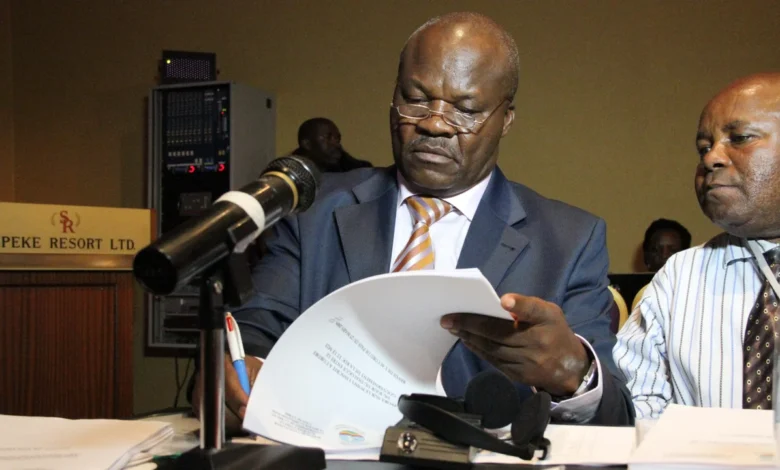
A French court has sentenced former Democratic Republic of Congo (DRC) rebel leader Roger Lumbala to 30 years in prison after finding him guilty of complicity in crimes against humanity committed during the Second DRC War.
The verdict, delivered in Paris on Monday, has been hailed by international justice advocates as a landmark step toward accountability for one of Africa’s deadliest conflicts, which claimed millions of lives between 1998 and 2003.
Prosecutors had sought a life sentence for the 67-year-old, accusing him of orchestrating serious abuses by fighters under his command.
Court president Marc Sommerer stated that Lumbala was guilty of ordering or assisting acts including torture, inhumane treatment, summary executions, rape amounting to torture, sexual slavery, forced labour, theft, and pillage.
The charges relate to a 2002-2003 military operation known as “Erasing the Board,” carried out in northeastern DRC by the Movement for the Liberation of the Congo and the Rally for Congolese Democracy National, an armed group backed by Uganda and led by Lumbala. The campaign targeted members of the Nande and Bambuti communities, accused of supporting rival militias. Lumbala’s lawyer, Hugues Vigier, declined to comment after the verdict.
The Second DRC War involved nine countries and resulted in over five million deaths, most caused by hunger and disease rather than direct combat. While some individuals have faced prosecution at the International Criminal Court, Lumbala is the first DRC national tried in a national court for atrocities committed during the conflict.
Lumbala was arrested in January 2021 under France’s universal jurisdiction law, which allows French courts to try crimes against humanity committed abroad. He refused to testify during the trial, which began last month, arguing that the French court lacked legitimacy, but was present when the verdict was delivered.
Yasmine Chubin, legal director at the Clooney Foundation for Justice, which participated as a civil party in the case, said national courts could greatly expand access to justice beyond the limited number of ICC prosecutions. “Universal jurisdiction tightens the net, giving victims more options and leaving perpetrators with fewer places to hide,” she noted.
One victim, 50-year-old nurse Pisco Paluku Sirikivuya from Mambasa, traveled to Paris to testify. He recounted that RCD National fighters had robbed and injured him, killed his uncle, and raped his friend’s wife in Ituri province. “I am deeply moved and very satisfied with this verdict. We have waited a long time,” he said, expressing hope that the ruling would serve as a warning to those who continue to commit atrocities in the DRC.