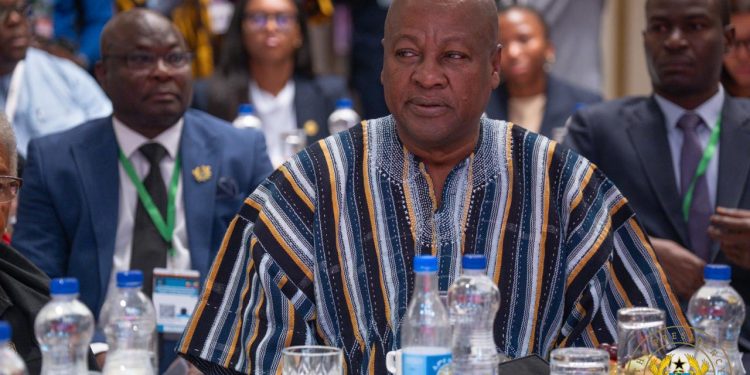
President John Dramani Mahama has called for a unified African stance on the legacy of slavery and racialised chattel enslavement, describing it as “the gravest crime against humanity.”
He made the call during a press conference at the African Union (AU) Summit on Sunday, February 15, where he urged African leaders and the diaspora to rally behind a common position to address historical injustices.
Resolution Anchored on Three Pillars
Addressing journalists, President Mahama emphasised that slavery is prohibited under international law as a peremptory norm from which no derogation is allowed.
He explained that Ghana’s proposed resolution on the issue is grounded in three key pillars: historical accuracy, legal defensibility, and continental and diaspora alignment.
“Our approach ensures that the text of this resolution reflects rigorous scholarship, moral clarity, and diplomatic credibility,” he stated, adding that Ghana undertook extensive consultations to strengthen the proposal.
Broad Consultations and Expert Input
According to the President, Ghana engaged several international and African bodies in drafting the resolution.
These include UNESCO, the Global Group of Experts on Reparations, the Pan-African Lawyers Union, academic institutions, the AU Committee of Experts on Reparations, and the AU Legal Experts Reference Group.
Earlier this month, Ghana hosted the inaugural joint meeting of the AU Committee of Experts on Reparations and the AU Legal Experts Reference Group in Accra to refine the resolution. Consultations were also initiated during the Ghana Diaspora Summit in December 2025 to ensure an inclusive and deliberative process.
Foundation for Reparatory Justice
Following expert input, the title of the resolution was refined to: Declaration of the Trafficking in Enslaved Africans and Racialised Chattel Enslavement of Africans as the Gravest Crime Against Humanity.
President Mahama said the wording was deliberately chosen to recognise the systematic trafficking of millions of Africans, the racialised and institutionalised nature of chattel enslavement, and its enduring global consequences.
“The resolution is not just symbolic,” he stressed. “It provides a legal and moral foundation for reparatory justice, African unity, and engagement with the global community on the historical injustices that continue to shape our societies.”
He added that the proposal seeks broad alignment across Africa and the global African diaspora to strengthen calls for justice and recognition.